
"Play Me Something"
What Bud Powell Came to Hear That Night

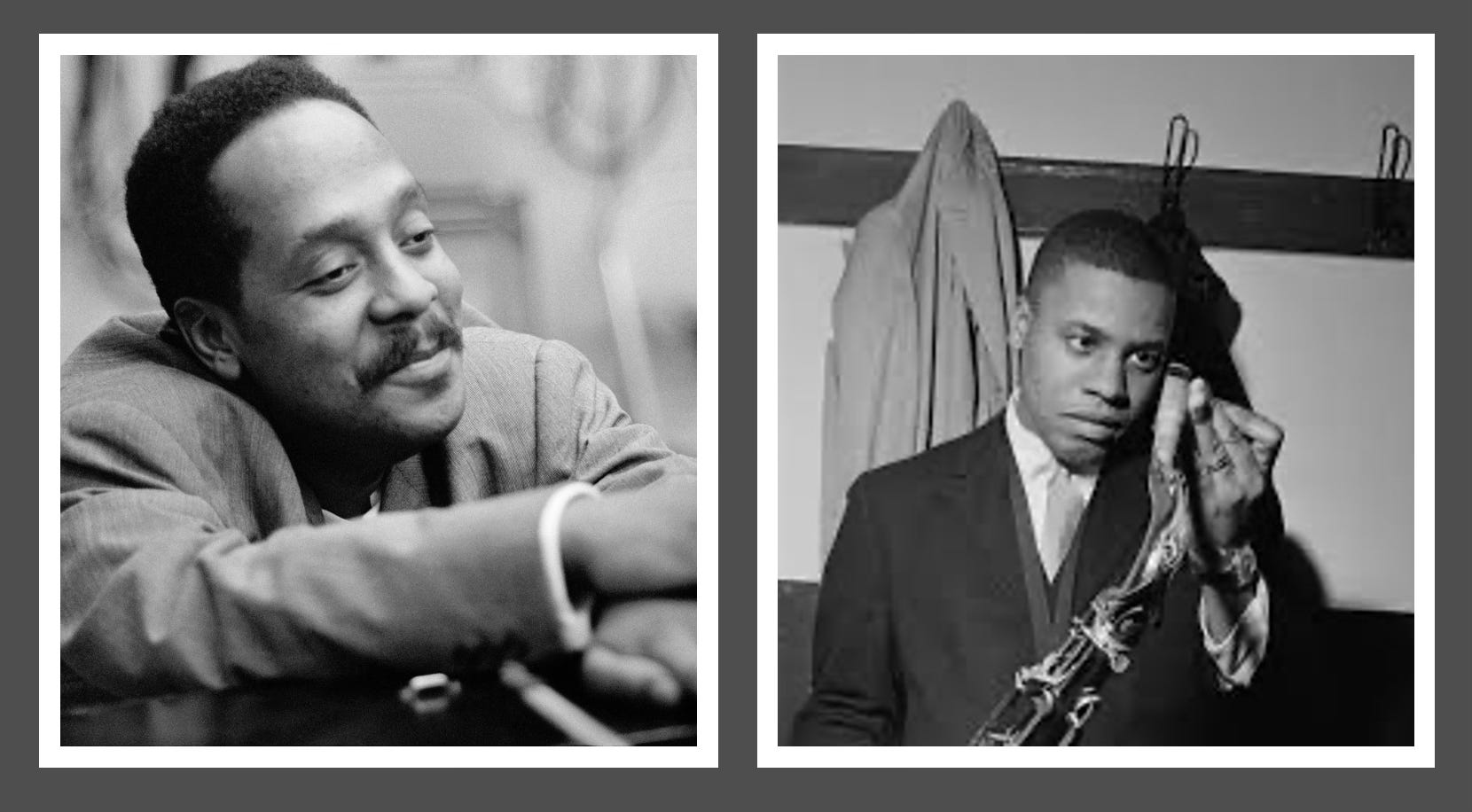
It’s three in the morning. There’s a knock on the door. Not a polite knock either—the kind that doesn’t wait for permission.
This is Paris, late ’50s, in a small hotel across the street from the Club Saint-Germain. Musicians are coming and going, nights bleeding into mornings. Art Blakey’s band had just finished playing, and the music was still hanging in the air, even hours later. And when the door opens, it’s Bud Powell.
There’s no perfunctory introduction or explanation. And certainly no small talk to ease the moment.
“Play me something,” he says.
He walks in still wearing his coat, beret on his head like he just stepped out for a quick errand and somehow ended up inside someone else’s life. He sits down—not settling in, not getting comfortable. Just sits.
Sonny Criss is staying in the same hotel. Everybody’s close. That’s how it was—music, rooms, lives, all stacked on top of each other. It lived up to the mythology.
Wayne’s horn is on the bed. He puts a towel in the bell. As one can imagine, the walls are thin, and there are other hotel guests within earshot, probably trying to get some rest before their morning cafe and croissant. We all know that real life never gives the musician total freedom.
And what do you play when Bud Powell asks you to play something?
Not some esoteric concept or a polished version of Coltrane’s solo on “Giant Steps.” And definitely not a demonstration of everything you’ve practiced that week.
Just a melody.
“Dance of the Infidels,” to be exact.
Simple and to the point. And let’s be real, it would be a fool’s game trying use your vast understanding of jazz language to impress the man who helped define the language in the first place.
Wayne plays the song one time through.
That’s it.
The horn goes down.
“Uh-huh,” Bud says slowly and approvingly.
He gets up and walks to the door. No critique. No breakdown. No profound lesson disguised as a conversation. Just a small acknowledgment, like he heard what he needed to hear.
On the way out, there’s a pause.
“You all right, Bud?” Wayne asks.
Bud gives him a look—a slight smile—and then he’s gone, down the stairs, back into whatever world his fading mind allowed him to understand.
The door closes.
And that’s the last time they see each other.
Years later, when they were making Round Midnight, the director Bertrand Tavernier wanted that story in the film. It had the shape of something important—one of those moments that feels like it explains more than it says.
But Bud’s daughter, Celia Powell, pushed back on how people understood it.
The assumption was simple: Bud wasn’t well. And if he showed up at your door, that meant something was wrong—that he was proabably lost.
She said no.
That’s not why he went. He wasn’t confused.
“Father went to Wayne’s room because he wanted to make sure everything was going to be all right,” she said.
“The future.”
That’s the part people don’t talk about enough—not the story, but the meaning.
Because on the surface, it sounds like a beautiful anecdote. A juicy piece of jazz history. A late-night visit from a legend. The kind of thing you tell at clinics or interviews.
But underneath it, something else is revealing itself. Something quieter. A question that’s a little unsettling if you sit with it too long.
Bud Powell didn’t ask for help. He didn’t ask for money. He didn’t ask for company. He didn’t even ask for a conversation.
He asked to hear something.
That’s it.
And maybe—though no one could say it out loud—there was something else in that moment. Not desperation or confusion, but a kind of awareness. The sense that his time among us no longer felt infinite. That whatever he had built, whatever he had carried, was now moving beyond him.
Because sound is the only place where you can’t fake the future.
You can talk about where music is going. You can theorize it, write essays, give lectures. You can even build entire careers explaining it.
But if you really want to know, you listen.
And think about the timing: three in the morning.
That hour when the world is stripped of performance. There’s no audience, no stage, no need to prove anything to anybody. Just one musician in a room, another musician listening.
That’s where the truth shows up.
We spend a lot of time today trying to secure our place in the present—building platforms, tracking engagement, making sure we’re visible, even during times when no one needs to know our business. All necessary, in their way.
But Bud wasn’t checking for visibility. He was checking for continuity.
Not: Are you working? Not: Are people paying attention?
But: Is it alive?
The music, that is.
Not is it correct or impressive.
But alive in the sense that it’s moving—that it’s not just repeating what’s already been said, but reaching for something it hasn’t quite figured out yet.
Those who know, can hear the difference.
And here’s the part that stays with me.
Bud didn’t stay long enough to explain anything. There was no “you should try this” or “watch out for that.” No passing down of secrets. No O.G. to youngblood exchange.
Just: play, listen, leave.
Almost like the question answered itself the moment the sound came out of the horn.
Maybe that’s what the future really is.
Not some distant idea we’re all slowly approaching, but something even the masters have to go looking for, quietly, every now and then—
to see if the language is still breathing,
if the music still has somewhere to go,
if somebody, somewhere, is hearing beyond what’s already been said.
Because if they are, the future is already here.
Deep. I was stunned to learn Ornette and Bud spent way more time together than is generally known.
Wayne, between this and his Lester Young encounter, the giants were giving him the keys
Not long thereafter, Wayne wrote "This Is For Albert," one of his finest compositions for Art Blakey and the Jazz Messengers, as a tribute to Bud Powell. (Bud's full name was Earl Rudolph Powell, but Wayne thought that it was Albert.). It was recorded in 1962.
https://www.youtube.com/watch?v=3Tdel_QACLM