
The Fan Illusion
Why Views, Comments, and Sold-Out Rooms Don’t Mean the Same Thing Anymore


The Visibility Paradox
Maybe you can relate to this.
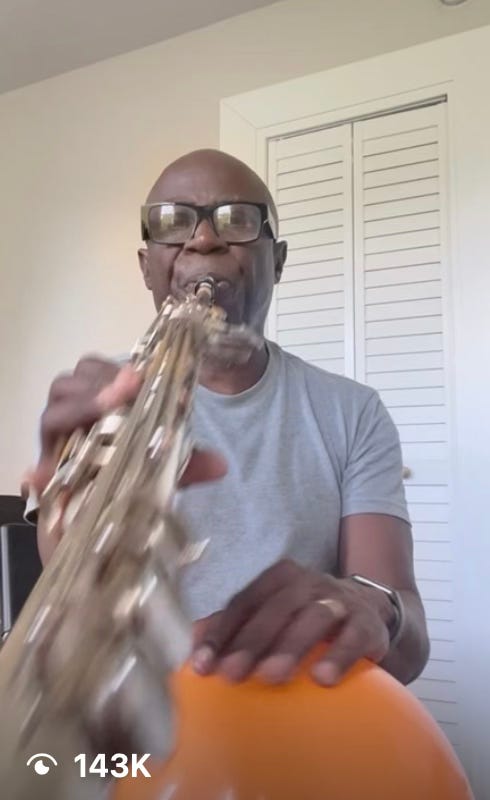
I’ll post a video on Instagram and it gets thousands of views. Thousands. People often comment, argue, tag friends, share it, and sometimes question the legitimacy of what I’m doing. This isn’t passive engagement by any means. It’s not background music on some generic playlist called Jazz for a Blue and Rainy Day. This is active, heated, and sometimes thoughtful engagement.
And then I’ll announce a gig across town and wonder if three people from that stream will walk through the door.
That’s not a complaint. It’s simply me recognizing the rules rearranging themselves.
It has me thinking about what we now mean when we say someone is “popular.” There was a time when exposure meant concentration. If you appeared on television or national radio, it meant something. This was the scarcity era, so there were only a handful of channels for a select few. Which also meant that there was a fairly direct line between visibility and turnout. Back then, the pipeline was narrow. And if you were in it, you were in it.
Now the pipeline is infinite. You can be everywhere and nowhere at the same time.
The engagement I receive is real. People aren’t stumbling onto my videos by accident. They’re choosing to respond. They’re typing, reposting, and sometimes debating. But performance in the social media realm is not commitment. It costs almost nothing to comment. You can participate without rearranging your life.
Attending a live show, on the other hand, requires planning, travel, money, and most of all, time. It asks someone to sit in a room for two uninterrupted hours. They’re asked to value the music enough to let it interrupt their lives.
A comment interrupts nothing.
Spectators, Participants, Stakeholders
Part of the confusion is that we’ve collapsed very different kinds of attention into one word: fan. The person who scrolls for thirty seconds and the person who rearranges their evening for a concert now sit under the same label. That flattening distorts everything.
Because there are, in truth, three kinds of engagement:
Spectators
Participants
Stakeholders
Spectators scroll, watch, and then move on.
Participants comment, debate, and share. They feel involved.
Stakeholders invest, buy tickets, subscribe, and show up. And most of all, they stay.
All three are real. But they are not interchangeable.
Strength in One Lane Doesn’t Guarantee the Others
And here’s where it gets complicated.
Very few artists hit all three categories with equal force.
Some dominate the spectator lane. Their clips will circulate. The comments pile up. Debates follow them around. My engagement probably falls closer to this, where I have strong reach and solid participation.
Stakeholders? That’s the muscle I’m still building.
Then there are musicians who barely make any noise online. Their posts drift quietly through the algorithm. But they’ll announce a show and they can pack a house. Their stakeholders are deep and loyal. These are folks who don’t argue in the comment sections on Instagram and Facebook. But they do something more tangible—they buy tickets.
My point is that one strength doesn’t guarantee the others. Weakness in one lane doesn’t cancel growth in another. The categories overlap, but they don’t automatically convert.
The Illusion of Conversion
That’s why the illusion is so easy to fall for.
The illusion happens when we mistake participation for stake, and assume engagement equals investment. Popularity today often means circulation, not commitment. It tells you whose name is moving. It does not tell you who can pack a club on a Tuesday night.
It also cuts both ways.
If we’re being honest, posting a clip and collecting spectators or participants doesn’t require much commitment from me either. I spend a few minutes recording something, I upload it, and it travels on its own.
That’s very different from the work of building real stakeholders.
Nurturing stakeholders means earning trust over time. It’s touring consistently, even when the guarantees are modest and the travel is long. It’s going into the studio and putting out a record that costs you something—time, money, emotional clarity—and then standing behind it long after the release week metrics fade. It’s showing up in traditional publications, not because they make you viral, but because they signal seriousness. It’s being seen in the physical world. Shaking hands, staying after the set, having real conversations with people who agreed to have their lives interrupted.
None of this scales quickly. But this is how stakeholders are formed. Not in five minutes of scrolling. But over years. Through repetition, consistency, and effort that doesn’t always look glamorous but builds something durable.
Low-friction output produces low-friction attention. High-commitment support almost always grows from high-commitment effort.
Playing Where the Ecosystem Already Exists
Now, let’s talk about gig ecosystems.
In New York, I tend to avoid gigs that depend on me to fill the room. If a venue is looking at me to pack the house, they’ll be very disappointed. That’s not insecurity talking. It’s math.
I gravitate toward places like Smalls or Mezzrow, where there’s already a built-in audience. A room that will be vibrant no matter who’s on the bandstand. In those spaces, the music can meet people who came out to hear something, even if they didn’t come specifically for me.
And I tend to go over better in those situations.
First, there’s already an audience committed to being there. They’ve decided that live music is worth their time that night.
Second, many of them have never heard what I do.
So when I step up to the mic with the soprano and start with all of my shenanigans — the multiphonics, the tube extentions, the chimes, the balloons, the Doppler Effect— it’s fresh. They’re not comparing it to a clip they saw five minutes earlier. They’re encountering it in real time.
And you can feel the shift, too. Curiosity soon replaces caution. The energy loosens. My shenanigans land differently when they’re experienced for the first time in a room built for listening.
It makes for a very good night.
There are venues I admire deeply. The Jazz Gallery. Even the Village Vanguard. But those spaces assume a certain kind of conversion from attention to turnout. And with the kind of music I play, that conversion isn’t automatic.
The spectators and participants that typically follow me, don’t instantly become stakeholders.
Not because the music lacks value. But because the pathways between categories are unpredictable. A thousand views doesn’t translate neatly into fifty tickets. Maybe not even two. A heated comment section doesn’t guarantee seats filled at the bar.
So I play where the ecosystem already exists. Where the audience isn’t waiting to be built from scratch. But where the music can enter a conversation that’s already underway.
And that’s not retreat, either. It’s strategy.
When “Fan” Meant Something
There was a time when the word “fan” meant something more specific. When I first moved to New York, a fan was someone who walked up after a gig and asked you to sign a CD or a piece of vinyl. They had already paid for the music. They had already given you their evening. And you stood there writing your name while they told you where they first heard you.
This kind of fandom requires movement, it requires effort, and intention. You knew who they were. They knew who you were. The engagement has weight to it.
Today, the word stretches across all three categories, and that stretching is where the confusion begins.
The Screen Dissolves
But it’s not all doom.
Several months ago, my wife and I went to a classical concert at The Juilliard School. We were just another couple in the audience. No soprano, no violin. No real musical skin in the game. And a young guy walks up and says, “Hey… aren’t you Sam Newsome?”
I paused. “Yes.”
He smiled. “My roommate and I love your Instagram videos. We trade them back and forth.”
I wasn’t expecting that. In that moment, the screen dissolved. The views had a face. Somewhere in a dorm room, two young musicians were passing my videos around like baseball cards.
That counts.
It didn’t translate into downloads, book sales, or reservations at my next show. But it was real. It reminded me that sometimes the impact is happening in rooms you’ll never see.
Reach as Its Own Currency
Maybe popularity doesn’t mean what it used to. Maybe it no longer guarantees turnout. Maybe it guarantees reach. And reach is its own strange currency. It doesn’t always convert immediately. It moves quietly off-screen, in dorm rooms, in practice spaces, in conversations you’ll never overhear.
I don’t know where it all leads. Some of it may disappear as quickly as it arrives. Some of it may settle somewhere deeper and resurface years later. Who knows?
What I do know is this: I’m still here. Playing, thinking, and putting the work into the world.
The room where the work is heard might be small. And sometimes the response might be loud. There will be days you won’t see any response at all. And that’s okay. Because lately, I’m less interested in measuring it and more interested in being inside it while it’s happening.
If someone trades a video with a roommate, that matters. If three people show up and listen closely, that matters. A conversation that sparks and fades still has weight.
At this point, I’m not chasing certainty.
I’m paying attention.
And for now, that’s enough.
When I was a young man, it was the club owners who relied on a live music policy to entice the public to come in and spend their money on booze. Now it is the musicians who are expected to do so. And if they’re not successful they aren’t asked back. Nevertheless, there is real competition to get into these venues.
A really thoughtful and deep article Sam....lots here to ponder !!!